

What Does Anti-Reflective Coating Actually Do?
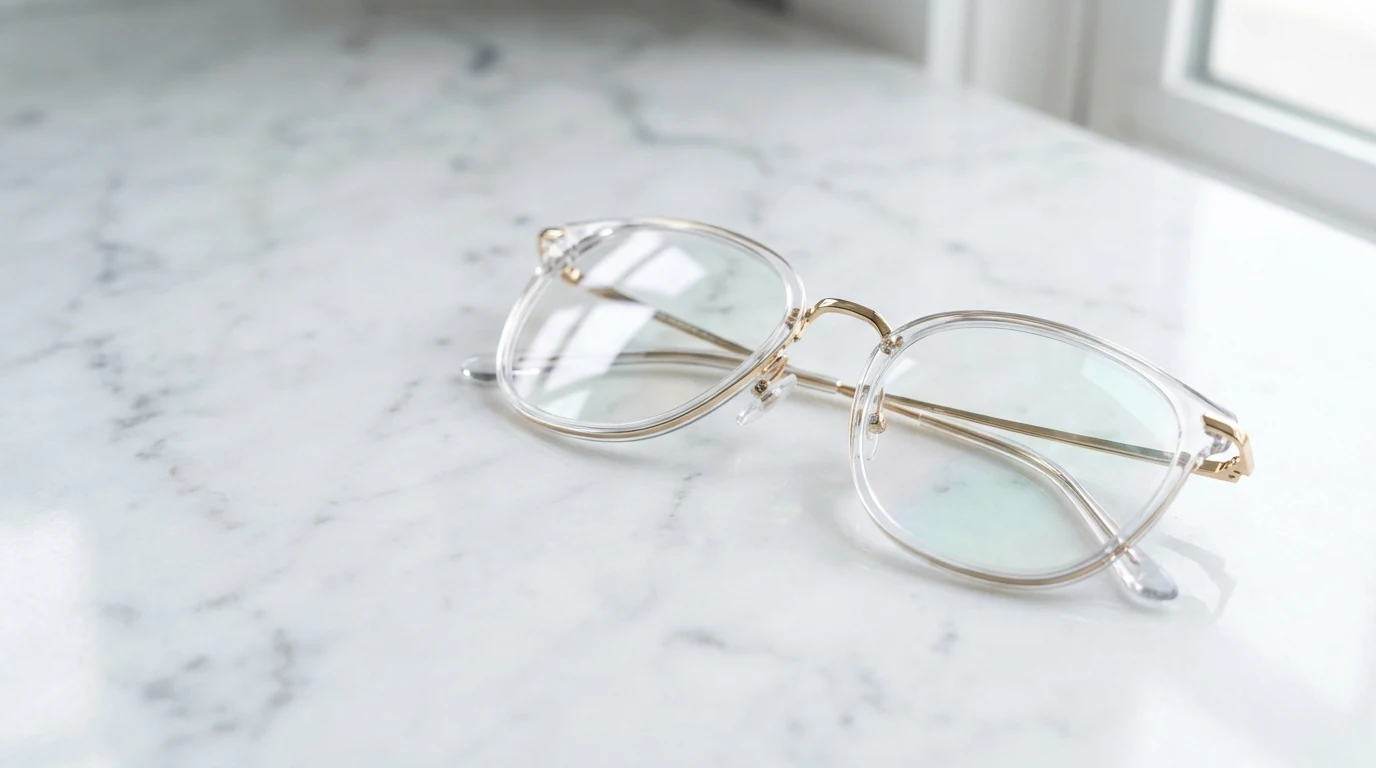
An uncoated plastic or glass lens reflects roughly 8% of incoming light at each surface, which means around 16% of available light is lost from a single lens before it even reaches your eye (American Academy of Ophthalmology, 2024). AR coating uses ultra-thin optical layers, typically magnesium fluoride stacked at precise thicknesses, to cancel those reflections through destructive interference. The result is that less than 0.5% of light reflects per surface and more than 99% passes through to the eye.
The physics behind this is elegant. Each coating layer is cut to roughly a quarter of a visible light wavelength, so the reflection from the air-to-coating boundary is exactly out of phase with the reflection from the coating-to-lens boundary. The two waves cancel. That's why tilted AR lenses show a faint green or purple residual colour: it's the narrow band of wavelengths the coating can't fully cancel at that angle.
Two things matter practically. First, video calls and face-to-face conversations: uncoated lenses in bright settings produce a ring or haze where your eyes should be. Second, and far more important, driving and screen use, where reflections directly reduce clarity at the moments you need it most.
See our full range of lens options and coatings.
Where Anti-Reflective Coating Makes the Biggest Difference
The clinical mechanism is well established: cutting lens-surface reflections from roughly 8% per surface to under 0.5% reduces disability glare and improves contrast sensitivity in low-light conditions. That matters because night driving is also where the risk is highest: fatal crash rates per mile are roughly three times higher at night than during the day (NHTSA). The reduction in halo effects and ghost images from oncoming headlights is the single most noticeable benefit for most wearers.
Night driving: In Mauritius, unlit coastal roads and an older vehicle fleet with unmodified headlights make this especially relevant. Patients in our practice who drive between Quatre-Bornes and the coast at night describe the first week with AR coating as "turning a dimmer up on the whole road."
Screen use: Monitors, phones, and tablets reflect ambient light back at you through your lenses. AR coating reduces that interference and makes long screen sessions less effortful. It isn't the same as blue-light coating. AR cancels reflected light across all visible wavelengths; blue-light filters absorb a narrow band of blue. They solve different problems.
Appearance: Uncoated lenses show a distinct sheen in photos and video. AR-coated lenses read as essentially invisible, which matters for video calls, ID photos, and anyone who spends professional time on camera.
Is AR coating useful for someone who only reads at home under warm lamps? Less so. The benefit scales with how often you encounter high-contrast light sources.
Why Back-Surface AR Coating Matters Most at Night
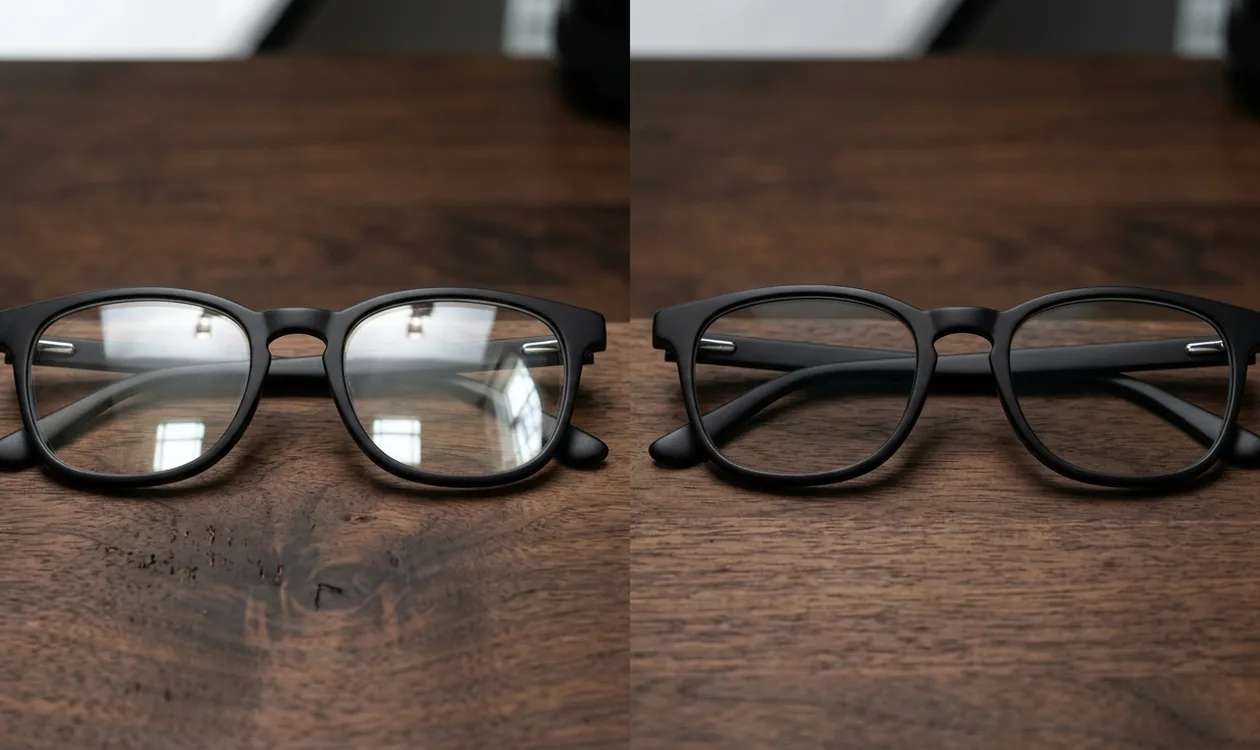
Most of the disruptive glare you see at night comes from reflections off the back surface of your lens, not the front. Think about the geometry. Headlights behind you, brake lights ahead, and streetlights above all bounce off the inner surface of the lens, the one closest to your eye, and create the bright halos wearers describe. The front surface reflections go back out into the environment and don't reach your retina. The back surface reflections do.
In our practice, this is the single detail most patients haven't heard before. When someone asks whether AR coating is "really worth it," the answer often lands when we explain that the back surface, the one they can feel pressing against their eyelashes when they clean, is the source of most night-driving annoyance. A front-only coated lens, which some older budget options used, solves only the cosmetic half of the problem.
Modern AR coatings are applied to both surfaces as standard. If a quoted price for AR coating looks unusually low, it's worth asking whether the coating is applied to both surfaces, and in how many layers. Single-layer, single-surface "anti-glare" is not the same product as a modern multi-layer coating on front and back.
A practical test: tilt a pair of coated lenses under a bright light. You should see a green or purple sheen on both sides of the lens, not just the outer surface. No sheen on the inner surface means no back-coating, which means no meaningful night-driving benefit.
How Long Does AR Coating Last, and How Should You Clean It?
A well-maintained set of AR-coated lenses typically holds up for 2 to 3 years under normal use. Modern AR is far more durable than the early 1990s versions that scratched easily and developed the classic "craze" pattern. Today the coating doesn't wear off uniformly; it accumulates micro-scratches that eventually show up as a cloudy or smeared appearance that cleaning can't fix.
The primary cause of premature damage is incorrect cleaning. It's almost always cleaning, not an impact or a drop. Dry wiping a lens with a shirt, a paper tissue, or a kitchen towel drags micro-particles across the coating under pressure. Even a single dry-wipe incident can leave hairline scratches that will never come out.
A simple routine keeps AR coatings intact for the full lifespan:
- Never dry-wipe. Rinse first, or use a lens spray. Wiping dry is the single most common cause of coating damage we see in the shop.
- Use a lens cleaning spray or lukewarm water. A few drops loosen debris before you touch the lens with a cloth.
- Only use a clean microfiber cloth. The one that came with your glasses, or a fresh replacement. Wash it every couple of weeks; a microfiber loaded with grease just redistributes oils across the lens.
- Avoid household cleaners. Glass cleaners with ammonia, kitchen surface sprays, and alcohol wipes can degrade the top hydrophobic layer of premium AR coatings.
- Keep glasses in a hard case when not worn. A closed case in a handbag or the glovebox prevents the scratches that come from loose objects.
In our experience, the patients whose AR coating lasts the full 3 years are the ones who never dry-wipe and always use a case. It's rarely about the brand of coating. It's about the habits around it.
See our full glasses and contact lens care guide for cleaning routines.
Standard AR vs Premium AR: Is the Upgrade Worth It?
Premium AR coatings typically add 15 to 40% to the lens price, and market research values the global AR coating market at USD 5.6 billion in 2025, growing around 6% annually thanks largely to premium tier uptake (Mordor Intelligence, 2025). Standard AR delivers the optical benefit, reduced surface reflection, with no additional surface treatments. Premium AR layers extra properties on top of the optical stack:
| Feature | Standard AR | Premium AR |
|---|---|---|
| Reduces reflections | Yes (~0.5% per surface) | Yes (~0.2% per surface) |
| Hydrophobic (water beads off) | Limited | Yes |
| Oleophobic (fingerprint-resistant) | No | Yes |
| Anti-static / dust-resistant | No | Yes |
| Scratch-resistant hard coat | Basic | Reinforced base layer |
| Typical added cost | Baseline | +15 to 40% |
The practical difference is meaningful for people who handle their glasses constantly, work in dusty or humid environments (both apply year-round in Mauritius), or find themselves cleaning lenses every twenty minutes. Humidity particularly matters here: the hydrophobic layer keeps lenses from fogging as dramatically when you step from air-conditioned spaces into the outside air.
For someone who cleans carefully, keeps glasses in a case, and doesn't spend long hours in dusty conditions, standard AR delivers the core optical benefit at lower cost. Children's first glasses are usually a good fit for standard AR. Adults with long commutes and screen-heavy jobs usually see the premium upgrade pay for itself in lens lifespan alone.
At D.Sungkur, every lens we supply includes AR coating as standard. The real question is whether the premium tier fits how you use your glasses, which is what a lens consultation is for.