
Eye Examination in Quatre-Bornes, Mauritius
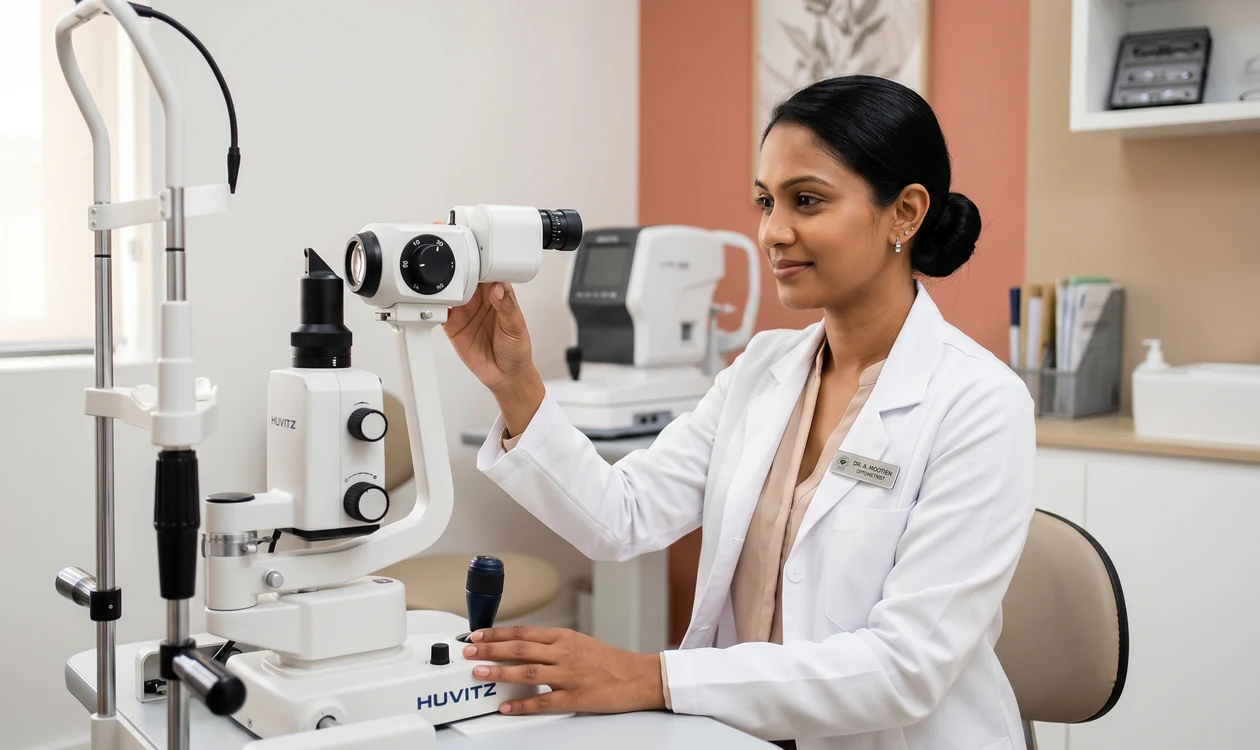
A comprehensive eye examination is the single most important thing you can do for your vision — not only to confirm whether you need glasses, but to screen for silent conditions like glaucoma, early cataract and diabetic retinopathy. At D.Sungkur in Quatre-Bornes, the full exam takes 15 minutes, starts from Rs 600, and is delivered by a registered optometrist using clinical equipment — not just a chart on the wall.
- Visual history and symptom review
- Objective and subjective refraction for a precise prescription
- Cataract and dry-eye screening
- Intraocular pressure measurement — first-line glaucoma check
- Direct examination of the retina and optic nerve — diabetic retinopathy and retinal-disease screening
- Colour-vision screening on request
- Written prescription issued on request (extra fee if no eyewear ordered)
- Referral letter to an ophthalmologist if a medical condition is identified
What happens during the 15 minutes
History & symptoms
A short conversation about your vision, symptoms, screen habits and family history shapes the rest of the exam.
Refraction
Automated objective reading in seconds, then subjective refinement with calibrated lenses — the classic "better or worse?".
Cataract exam and tear film
Screens for early cataract and dry-eye disease.
Pressure & retina
Intraocular pressure for glaucoma screening plus a direct look at the retina and optic nerve — diabetic retinopathy included.
We start with a short conversation — your current glasses or lenses, any headaches, blurred vision, family history of glaucoma or diabetes, screen hours and driving habits. This context shapes the rest of the exam: a 16-year-old student with fluctuating near vision, a 50-year-old starting to hold their phone at arm's length and a diabetic 65-year-old all need different priorities.
The refraction happens in two stages. An automated reading first gives us a precise objective starting point in a few seconds. We then refine it with calibrated lenses while you read the chart — the familiar "better or worse?" sequence — to arrive at your exact prescription for distance, reading or both. For young children and patients who can't easily answer, we switch to an objective technique that reads how light reflects off the back of the eye — so the measurement doesn't depend on verbal feedback.
We then examine the front of the eye — tear film and crystalline lens. This is the step that screens for early cataract and for dry eye disease, both common in Mauritius and often overlooked. Intraocular pressure is measured for a first-line glaucoma check — glaucoma damages vision silently, without pain, and is one of the leading causes of preventable blindness. A direct look at the retina and optic nerve is what identifies diabetic retinopathy and other retinal conditions — a particularly important screen in Mauritius, where diabetes is highly prevalent. When asked — for certain professions — we add a colour-vision test. You leave with a clear diagnosis and, if you need one, a written prescription (admin fee applies when no eyewear is ordered).
What we check — and why it matters
Beyond the glasses prescription, the exam screens for six conditions that can affect your sight over time — several of them silent in their early stages.
Refractive errors
Myopia, hyperopia, astigmatism, presbyopia. We measure the exact correction you need for clear distance and near vision.
Glaucoma
Damages vision silently, without pain. Early detection through intraocular pressure is what preserves sight — once lost, it cannot be recovered.
Cataract
A clouding of the lens, common after 50. Detected early it's monitored; surgery stays highly effective but becomes urgent if left too long.
Diabetic retinopathy
Diabetes damages the small blood vessels of the retina. In Mauritius — where one adult in four is diabetic — annual screening is essential.
Dry eye disease
Common and often overlooked. Causes blurred vision, stinging and screen fatigue — very manageable once identified and treated.
Colour vision deficiency
Matters for driving, certain professions and schoolchildren. Screened on request — a quick check that can change a career path if caught early.
Pricing: from Rs 600, with flexibility
The starting price of Rs 600 covers a standard adult comprehensive eye examination. A few situations are priced separately because they involve more time or additional testing:
| Situation | Duration | Price |
|---|---|---|
| Standard adult comprehensive exam Refraction, eye-health check, pressure, retina |
15 min | From Rs 600 |
| Paediatric exam Retinoscopy, binocular vision, ocular alignment |
About 30 min | Call for quote |
| Written prescription without an eyewear order Administrative fee if you fill elsewhere. Included if you order with us. |
— | Admin fee |
| Soft contact-lens fitting and education Spheric, toric, multifocal — see our contact-lens guide |
Varies | Priced separately |
| Post-surgery or complex medical follow-up Extended consultation time |
Varies | Case by case |
Many patients pay nothing out of pocket. We bill your eye exam and eyewear cashless — directly to your insurer, with no upfront payment and no reimbursement paperwork — through Swan, Medscheme, Eagle, Linkham, IBL Provident, Mosanté and SanlamAllianz. We also handle Sicom, NIC and MUA reimbursements, and CIM Finance instalments in-store. See how cashless billing works before you book.
Not sure which applies to you? Call 463 2371 or WhatsApp +230 5774 2687 — we'll confirm the price for your situation before you come in.
Who should book an eye exam
Adults under 40
Every two years, even if your vision feels fine.
Adults 40+
Annually. Presbyopia, early cataract and glaucoma risk all rise in this window.
Children and teenagers
Annually through the school years. Children rarely complain because they assume everyone sees the world the same way. See our signs a child may need glasses.
People with diabetes
Annually, regardless of age. Diabetic retinopathy is a leading preventable cause of blindness — we screen for it during the exam.
Anyone with new symptoms
Blurred vision, persistent headaches, sudden light flashes, new floaters, or difficulty driving at night. Don't wait for your next routine check.
Heavy screen users
Office workers, students, remote workers. Digital eye strain is manageable once identified — read our guide on digital eye strain.
How to prepare for your appointment
Bring your current glasses or contact lenses, even if you only use them occasionally — we need a reference point.
Bring your latest prescription if you have one (from a previous optometrist or abroad).
Contact-lens wearers: if we are also fitting lenses, wear your glasses to the appointment or remove your lenses 1–2 hours before.
Frequently Asked Questions
How much does an eye exam cost in Mauritius?
A standard adult comprehensive eye examination at D.Sungkur starts from Rs 600. Paediatric exams are priced slightly higher because they involve additional testing (accommodation, binocular vision, cover tests). Issuing a written prescription without an eyewear order also carries a separate fee. If you're unsure which applies to your situation, see the pricing section above.
How long does the exam take?
The adult exam is scheduled for 15 minutes and covers history, refraction, screening for early cataract and intraocular pressure measurement. Paediatric exams take around 30 minutes (retinoscopy, binocular vision, ocular alignment). Complex cases may need more time — we'll advise you when you book.
Do I need a referral from my GP?
No referral is required in Mauritius. You can book directly with an optometrist. If the examination reveals a medical condition (advanced cataract, diabetic retinopathy, glaucoma), we refer you to a collaborating ophthalmologist with a written report.
Do you screen for cataract during the exam?
Yes. We examine the crystalline lens and identify early cataract changes. Combined with intraocular pressure measurement, this also provides a first-line glaucoma screening. If a cataract is detected, you receive a written report and a referral to an ophthalmologist when surgical assessment becomes appropriate.
How often should I have an eye exam?
Adults under 40: every two years. Adults 40+: annually. Children in school: annually. Diabetics: annually, regardless of age. Sooner if you notice blurred vision, headaches, eye strain or visual disturbances. Read our full guide: how often should you have an eye test in Mauritius.
Can I get just a prescription without buying glasses?
Yes. We issue a written prescription on request — it is yours, and you are free to have it filled anywhere. A separate fee applies for a prescription-only visit. If you order glasses or contact lenses with us, the prescription is included in the service.
“Excellent eye care and service. Great experience with a professional Optometrist and friendly staff. The eye exam was thorough, and the frame selection was stylish and high-quality. Highly recommend!” — Harrydas Mungur · verified Google review
Disclaimer: This page describes an optometry service and is provided for informational purposes. It is not a substitute for a clinical consultation. Prices are indicative and may be updated; the final price is confirmed at the consultation. D.Sungkur Optometrist Ltd is regulated by the Optical Council of Mauritius.