

How Do You Know Your Prescription Is Outdated?
Adult refraction typically drifts 0.25D to 0.50D per year after age 40, enough to be noticed within 18 to 24 months and enough to produce headaches, strain, or reduced contrast at night (typical clinical experience). That shift is too small to register day to day. The eye adapts, compensating with extra muscular effort, until the compensation itself becomes the problem.
Are you pulling the screen closer? Holding the menu at arm's length? Tilting your head to read a sign? Those are all compensations. None of them cost you sight. All of them cost you energy.
The clearest signs an update is overdue:
Headaches and eye strain. When the prescription is no longer accurate, the focusing system works harder to resolve a sharp image. That sustained effort produces tension headaches, usually behind the eyes or across the forehead, and fatigue that arrives earlier in the day than it used to.
Squinting at distances you used to manage. A sign the distance correction has shifted. If you're narrowing your eyes to read a sign or a screen from across a room, the prescription that covered that distance no longer does.
Difficulty in low light. Reduced contrast sensitivity and slower adaptation to dim environments are normal with age, and they're amplified significantly by an incorrect prescription. Night driving in particular becomes harder when lens power no longer matches current refraction.
Blurring that clears with a blink, then returns. Usually a dry-eye sign (the tear film breaks down faster than it's replenished), but it can also indicate a lens that's no longer sharp enough to resolve without reflex effort.
If two or more of these apply, the prescription almost certainly needs checking. Learn about dry-eye causes and treatment.
What Does a Prescription Update Appointment Actually Include?
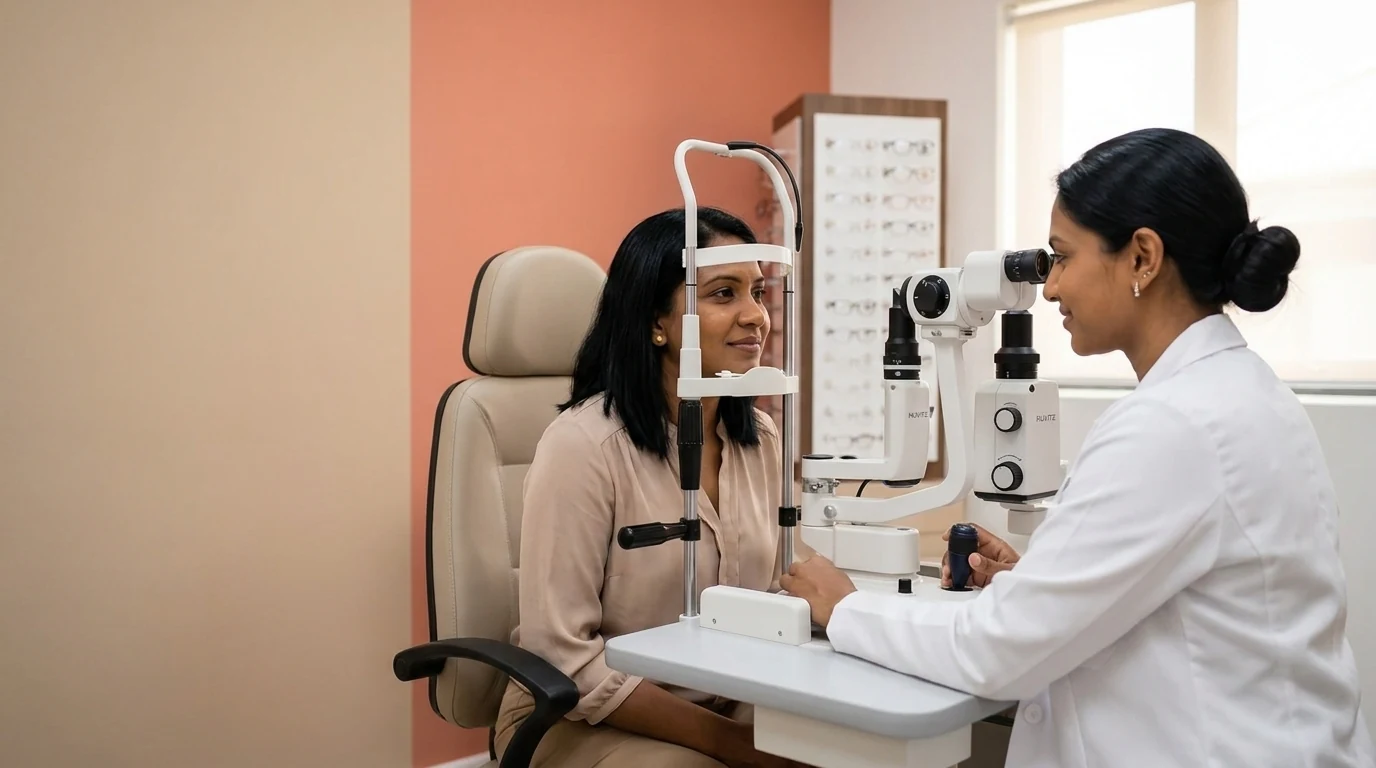
A standard comprehensive adult eye examination takes 30 to 45 minutes and covers both refractive accuracy and ocular health (AAO Preferred Practice Pattern, 2024). The refractive portion (the part that determines your new lens prescription) is straightforward. Using objective measurements plus a subjective refraction, the familiar "better one or better two" test, your new power is confirmed to the nearest 0.25 dioptre.
The appointment then continues with:
- Intraocular pressure measurement. Elevated IOP is the main risk factor for glaucoma, which causes no pain or early symptoms and affects roughly 76 million people worldwide (Tham et al., Ophthalmology, 2014).
- Dilated fundus examination (where indicated). Direct assessment of the optic nerve, macula, and peripheral retina, particularly important for diabetic and highly myopic patients.
- Anterior segment examination. Cornea, crystalline lens, and lid margins. Relevant for contact lens wearers and for detecting early cataract changes.
- Binocular vision and ocular motility check. How well the eyes work together under sustained near-viewing demand, which matters enormously for screen workers.
For adults in Mauritius, where diabetes prevalence sits at 19.9% of adults (IDF Atlas, 2021), this health-check element isn't optional. It's where diabetic retinopathy is first detected in patients with no visual symptoms at all. In our Quatre-Bornes practice we see this pattern several times a month: about one in five diabetic patients who book "just for glasses" leave with a referral for retinopathy monitoring they weren't expecting, and a small but steady share of routine exams turn up incidental findings, an early cataract, raised IOP, a retinal change worth watching, that the patient had no idea about.
How Often Should You Update Your Glasses Prescription?
The American Academy of Ophthalmology's Preferred Practice Pattern recommends comprehensive eye examinations every 1 to 2 years for adults under 40 with no risk factors, and annually from age 40 (AAO, 2024). Several factors shorten that interval, and in Mauritius at least two of them apply to a meaningful share of patients.
| Risk profile | Recommended interval | Why |
|---|---|---|
| Adult under 40, no risk factors | Every 1 to 2 years | Refractive stability; low disease prevalence |
| Adult 40 and over | Annually | Presbyopia progression; cataract and glaucoma screening |
| Diabetes (any age) | Annually (dilated) | Diabetic retinopathy screening; refraction can shift with glucose |
| High myopia (−3.00D or greater) | Annually | Higher risk of retinal tears and lattice degeneration |
| Children with active myopia progression | Every 6 to 12 months | Catch progression early; adjust myopia-control strategy |
| Family history of glaucoma | Annually from 35 | Earlier IOP monitoring recommended |
If you're unsure how long it's been, check the date on the prescription you received at your last examination. Most prescriptions in Mauritius carry an issue date. If it's more than 18 months ago, it's worth booking. See our full guide on how often to get an eye test in Mauritius.
Can You Use an Old Prescription to Buy Glasses Online?
Online eyewear is a third of the global optical market and growing, with the online eyewear segment projected to reach USD 13 billion by 2028 (Statista, 2024). Many patients now ask whether they can take a prescription more than two years old and order a new pair online. Technically yes. Clinically, it isn't usually a good idea.
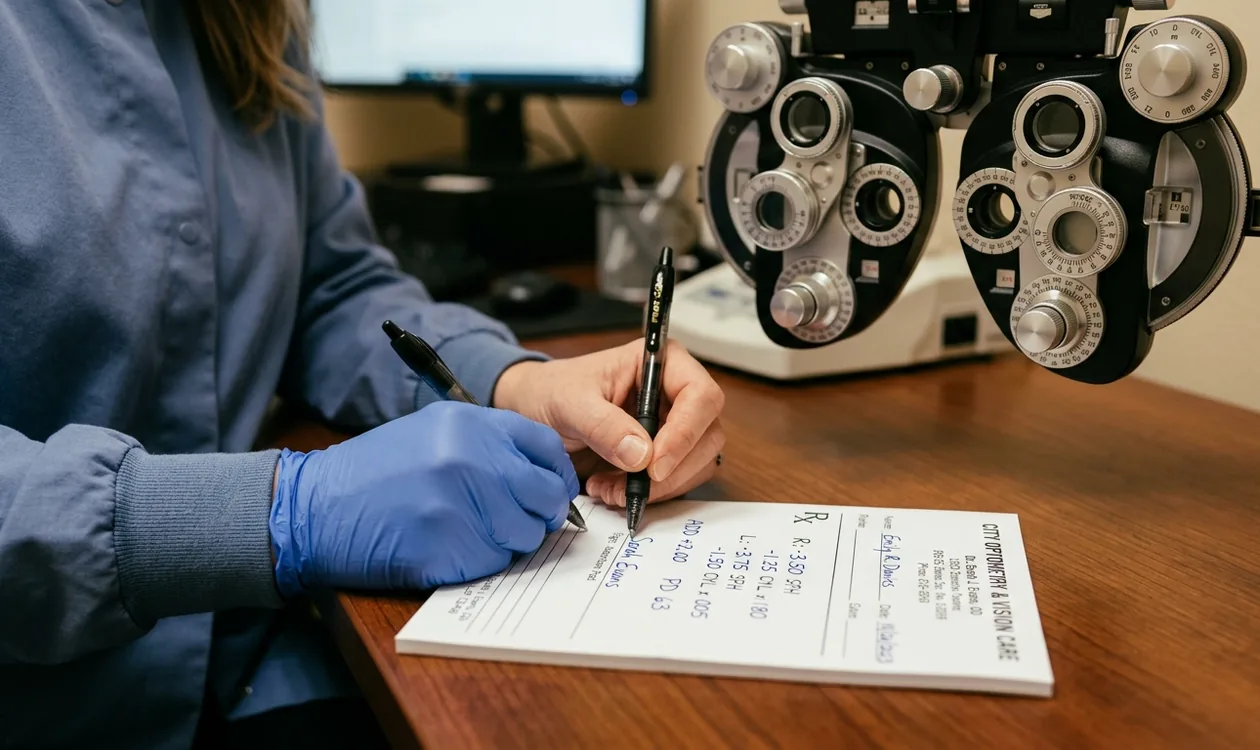
Two reasons. First, refractive drift of 0.25D to 0.50D per year after 40 means a two-year-old prescription can easily be off by a full dioptre. That's enough to cause exactly the strain symptoms most people are trying to solve by getting new glasses in the first place. Second, pupillary distance (PD) measurements from an old prescription may not be recorded, or may have been taken for a different frame shape. An incorrect PD induces prism and is a common source of "these just don't feel right" complaints after online orders.
A practical compromise: book a short refraction-only appointment, get a fresh written prescription with a current PD measurement, then use it to order online or in-store as you prefer. Most Mauritius practices, including ours, will release the written prescription to you without obligation to buy the lenses from them. It's your data.
Starting the Year with the Right Prescription
Behavioural research on January goal-setting shows habit-formation windows are genuinely real, with self-reported success rates for resolutions set on 1 January roughly double those of goals set at arbitrary points in the year (American Psychological Association, 2023). There's nothing uniquely medical about January, but the start of a new year is a reliable prompt for deferred maintenance. A prescription update is one of those tasks that's easy to postpone indefinitely, because the need is gradual and the disruption is manageable.
Booking it now means the whole year ahead runs on accurate correction. In our Quatre-Bornes practice we've found that patients who combine the refraction with a frame selection in a single morning tend to wear the new pair consistently from day one. Splitting the two visits, exam first, frames a week later, is where motivation quietly leaks out. That pattern holds whether the update is a tiny 0.25D shift or a full dioptre.
When did you last update your prescription? If the date on the paper you received is more than a year old, January is as good a moment as any to book. A single appointment covers both the updated prescription and a full eye-health check, including intraocular pressure and retinal assessment.